
A lifetime in the water
Est. reading time 2 minutes
From Kennedy Lake to the Swim Club
My introduction to swimming was not conventional - more hippy. When we moved from Edmonton to Ucluelet in 1973, I was five years old. Kennedy Lake became my playground. It’s the largest freshwater lake on Vancouver Island, and a pretty serious place to learn how to swim. Lessons weren’t really a thing back then. The guidance was simple: don’t drown.
Later, after moving to Victoria, a neighbour mentioned she was heading to the Juan de Fuca Pool to swim with the Cohos. I tagged along. That decision ended up shaping most of my youth and a good chunk of my adult life.
The Era of Strict Taskmasters
Anyone who swam competitively in the 70s or 80s remembers the coaches. Mine were characters. One was Howard Firby, who had coached Olympic swimmers. By the time he got to us, he ran a tight ship. If you stopped during a set or put your feet down, a kickboard might come flying your way. His most useful advice was also the simplest: “You’re better off breathing every second stroke than every fifth.”
It worked.
Then there was Jacques Noble—an old Englishman, former boxer, and a completely different presence. If you placed top three at a meet, he’d buy you ice cream. Same goal, very different style.
Of all the coaching I've ever received, Ken Olsen was the best, without question.
The Gorilla Years
By fifteen, things got serious. I was qualifying for Olympic trials, which meant swimming seven to eight kilometres a day, every day, plus dryland training. My dad started calling me “the gorilla” because all I did was eat, sleep, and train.
What appealed to me then—and still does now—is the honesty of swimming. It’s just you and the clock. If you get faster, doors open. If you don’t, they don’t. No excuses.
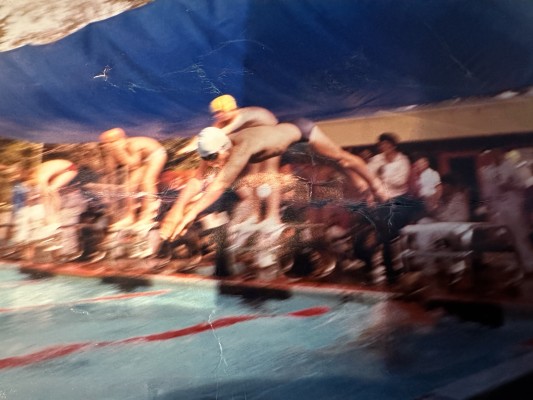
At the same time, I was playing fastball for Langford. We won four provincial championships in a row. Swimming gave me something solitary and exacting; ball gave me the team, the camaraderie. Between the two, it was a good balance.
Coming Full Circle
After a long break for work and life, I found my way back to the pool in my mid-forties. These days I swim four to six kilometres a week. I’m not chasing times anymore, but I still care about how I move through the water.
A friend at the Y—who happens to be a former Brazilian Olympic swimmer—calls me “The Octopus” because of my alignment and lack of drag. I told her, “I’m an old man. All I’ve got left is technique.” Well, I try hard to keep my form.
Why I Still Dive In
Swimming has been good to me. It’s zero impact, and somehow I’ve avoided the shoulder issues that catch up with a lot of athletes. My dad likes to point that out. I chalk it up to a simple belief: motion is lotion.
The pool also gives me something I don’t find elsewhere. There’s a rhythm and a sensory focus to it that’s hard to replicate on a bike or a treadmill. It quiets things down.
At this point, it’s not about competition or nostalgia, though there’s a bit of both. It’s about showing up, moving well, and staying connected to something that’s been part of my life from the beginning. Keep moving.